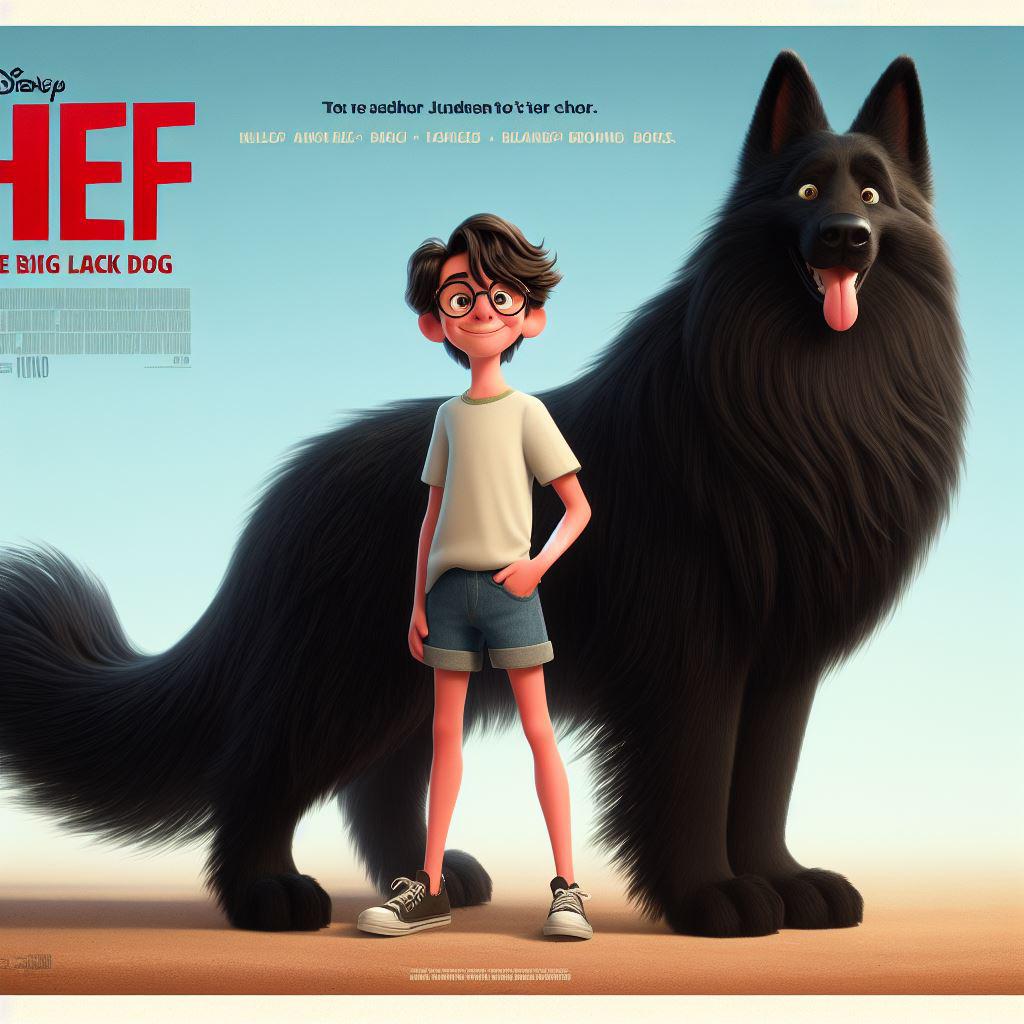
By David Torres
Prologue
The story you are about to read is not merely about a pet and their owner.
It is about the profound partnership between a human being and a dog, working side by side, day after day.
This relationship underscores the significance of long-term interaction between two beings, bound by trust, respect, and mutual reliance.
Chief was raised to assist his human companion. Imanol—whom I affectionately call Pilou—not only depends on Chief to complete various tasks but also values him as a loyal and irreplaceable companion. However, their journey has not been without challenges.
In their own country, they have faced resistance and prejudice. Service dogs like Chief are often denied access to establishments, with restaurant staff frequently attempting to relegate him to the patio.
Having a service dog is not always convenient. In fact, in many ways, it presents unique difficulties. Yet, change is happening. Slowly but surely, societal attitudes toward people who rely on service dogs are beginning to evolve in our country.
As I write these words, Pilou is being interviewed by the BBC in London. Somehow, I feel this book was destined to coincide with such a significant event. It fills me with wonder to see Pilou and Chief appear on Britain’s national television.
Later this week, they will return to Mexico to continue their lives together. I hope this book sheds light on the importance of human interaction—not just with animals but with all living beings.
At the airport
I find myself standing in front of a window where the staff is responsible for reviewing permits to leave the country. The place is Mexico City’s airport.
I nervously check the time and focus my gaze on different targets. I look at my suitcase, then my backpack, then Chief’s documents, and my inquisitive eyes dart back and forth like in a basketball game, here and there.
I hear the officer at the window continue asking for papers, and more papers, and even more papers so that one of the members can fly: a dog named Chief. The person in charge of the dog, with a lot of patience and courtesy, complies with the official’s demands.
«My God, how many more papers are needed?» I wonder. A voice in my head tells me, «Be patient.»
I look at Chief. He is a beautiful service dog. A long-haired German Shepherd. I admit that in Mexico, I’ve seen very few of them. They are often confused with Mexican dogs called «Calupos.»
Chief is a bear, a wolf, he is impressive.
He’s flying for the first time, on a transatlantic trip. He’s just over a year old and is already classified as a «service dog.» He still has some tests to pass, but let’s say he’s about eighty percent ready to fulfill his role.
An international association granted him permission to be officially recognized as a «service dog.»
«Chief was born to work,» I tell myself. He is not aware of this, but he came into the world to be a service dog.
He learned through play, as it should be. Play is a magnificent way to learn, I think.
As young as he is, he will provide his owner much more than just emotional support. Chief is equipped with many tools that we will discover over time.
The dog is carefree. I see him lying down calmly. Being with his owner makes him feel comforted.
I’m lost in my train of thought when the officer at the window decides it’s enough and hands over the authorization from the Ministry of Agriculture, known as SAGARPA.
We have the green light for Chief to leave the country.
The owner knew all along that everything was in order. His characteristic is and has always been to have all of Chief’s documents on time and in order. He is a very organized person.
As for me, I remain nervous, perhaps because I love flying, even though it gives me stomach knots before doing it.
«Let’s head to the airline,» my group shouts in unison, and they rush off with a «Eureka, we did it!»
At the airline counter, once again, they ask for papers, and more papers. «What a tedious matter,» I think to myself.
The airline’s front desk agent asked for one more document and began to argue with the owner. «How nerve-wracking,» I say to myself mentally.
Then, boom! The supervisor appears like a hero and gives the clear instruction to the agent to allow the dog to board the plane.
The agent warns us that if the dog is not accepted at the destination, it might be because of that document. But at the destination, they accepted the dog perfectly, and he went from having Mexican nationality to having dual nationality. Wow! A dog with dual nationality!
In the group, the discussion turned to saying that this or another airline was more flexible. I believe this would have happened on any airline. Then I recall an incident we had with Ryanair in Copenhagen.
It gives me the idea that if a supervisor is in a bad mood on a certain day, the dog might not board, and that’s it.
In Chief’s case, he doesn’t travel as an extra passenger because, in a way, he’s an extension of his owner. A helper like a prosthetic, and therefore, a true service animal.
He doesn’t pay an extra fare, but he has to be accommodated in the seat. Seeing the dog, one wonders where in the more commercial section of the plane he could fit.
I’ll explain some of Chief’s duties and how he travels on a plane later.
Thus begins the first adventure of this dog, on a flight where he will cross the Atlantic to go with his owner to the Old World.
Many more adventures will come. Chief was born to serve and has the best will to work in what he was bred for.
Is there a dog on the plane? Has anyone seen it?
Chief is not only imposing but also has beautiful fur. His appearance does not go unnoticed. Once on the plane, his owner and he took the last seats on the plane, where the dog has more space to stay on the floor. The animal has a very stable temperament. So, upon arriving, he lay down next to his owner. That’s how he’ll spend most of the time, except for the moments when he’ll walk to stretch his legs in the aisle.
The flight attendants sighed when they saw him and expressed their admiration. Still, Chief is working using his keen sense of smell and senses. During the flight, the role of one of these dogs is more than just providing emotional support. He is equipped with special diapers and supplemented with the help of a mat where he can go to the bathroom. Nevertheless, the owner took precautions so that, on such a long flight, his physiological needs are minimal.
Therefore, the owner and the animal are very calm during the flight, and the passengers barely notice the dog’s presence. If you’re interested in learning more about Chief’s training, I’d be happy to share more information with you. Upon arriving in Europe, we proceeded to register the dog’s entry, which went smoothly. We immediately noticed that in Spain, the openness to people with special needs who require dogs is very common. But I’ll talk more about that later.
The country welcomed us wonderfully, and we could instantly tell that Chief and his owner would feel at home in this beautiful country.
I’m feeling at home or even better.
Chief saw the light in Germany and was transported to Mexico. He was born very close to Cologne. To perform his duties, his owner had a vest made with the words «service dog» and attached a badge indicating that he is a service dog. Additionally, he included an article of Mexican law, which mentions the obligation of establishments to allow the owner to enter with the dog.
Even so, the owner had to face, so to speak, “opening paths.” Once, for example, a chain of cinemas did not allow the dog access, which resulted in them being reprimanded. Shortly afterward, the chain apologized to Chief’s owner and even offered him sweets and popcorn. But the owner was not going to take advantage of this situation and only wanted to be able to go to the movies.
On another occasion, a major retail chain also denied the dog access. Later, they also apologized. It is not very common to see that type of canine specimen walking with their owners. In Mexico City, it is more common. There are many factors why dogs like this are rarely seen, primarily the costs of raising the animal.
Still, Chief has been opening doors, demonstrating and bringing his stable character to many places. The dog conveys a lot of tranquility, and later, we will see how he was selected.
Upon arriving in Spain, the first thing Chief’s owner noticed was that this country is very open to service dogs. The limitations are found on some beaches. In Valencia, Spain, for example, it is not permitted for the dog to go to a public beach, and there is a beach far from the city, specifically for going with the animal. Our conclusion is that it is very likely that in Spain, this rule applies in other regions.
Even so, Spain not only welcomed Chief with open arms but also extended him his passport for the Eurozone without any problems.
Trains, Trams, and Other Means of Transport
Sometimes, someone notices a furry black animal underneath the seat. It could be on a tram, the underground, or a train. They are often surprised when they realize the size of the animal. It turns out to be Chief, who has made himself comfortable below the seat. His beloved human owner always ensures he is placed where he won’t obstruct the passage.
However, dogs are not usually allowed on public transportation, so it’s very important to carry Chief’s permits. We noticed that in Eastern European countries, there are many inspectors strictly enforcing the rules. The underground was filled with these inspectors, watching every corner with an eagle eye.
We didn’t have much trouble on trains, but it’s essential to carry the proper documentation. Otherwise, inspectors will issue a fine, and it’s usually a hefty one. Chief, as always, remains calm. When he’s with his owner, the world could fall apart, and he would still be a happy dog.
In another chapter, I will share how Chief became a service dog and describe his special traits. I’ll also tell you how his master, whom we call «Pilou,» helped train this incredible dog. Before Chief, there was his predecessor, another amazing dog named Keppler, after the famous scientist.
Who is Pilou? Why do we call him «Little Fluff»? I think this boy is a miracle. His mother had certain complications during his birth, but he entered the world as an extraordinary little human being. Smaller than average, he remained small as he grew up.
When I first met him, he reminded me of the little boys and girls from Dr. Seuss’s books. He was an extremely shy little boy, so I created a story about a small monster and his struggles to be the best at scaring small kids. He loved the story of the Little Teensy Hairy Monster. That’s when I nicknamed him Pilou, which means «Little Fluff» in French (at least, I believe that’s the meaning of his nickname).
Keppler the Jumping Dog
Our story is about dogs and their magical effect on humans. Pilou will appear occasionally to give context to the adventures of Chief, a working dog.
When Pilou was around fourteen years old, he had a lot of trouble socializing. He found it stressful to communicate with people his own age. Being intelligent, we had a chat where I explained to him that making friends isn’t about age but about common interests. A few days later, he came up with the idea of getting a dog.
He chose a Border Collie, a breed known for its energy and herding abilities. By then, everyone except me knew they were sheep-herding dogs. And so, Keppler joined our family. We already had a Schnauzer, and eventually, our pack included Keppler, another half-blooded Border Collie, and little Frodo (the Schnauzer).
Through raising this incredible and playful dog, Pilou began to communicate better with his peers as well as his teachers. Joyfully, we found a school where Keppler was allowed to attend once a week, becoming part of the school group. It wasn’t an ordinary group; it was composed of not just regular students but also those with special conditions like autism, physical disabilities, and other health issues—not necessarily mental conditions.
Keppler worked magic among the pupils, as many started to communicate more and interact positively.
I could talk for hours about Keppler, but one thing is particularly relevant to this story. Keppler became a very intelligent dog. His life was marked by a digestive disorder, so Pilou knew that every day of Keppler’s life was precious.
One day, my beautiful daughter Fernanda suggested that Pilou teach other dogs. Pilou had a special gift for communicating with these mammals, so he took the opportunity and began a new chapter in his life. He gained new clients, and his confidence grew.
We saw great changes in his personality—he transformed from a closed clam to an open one, revealing a beautiful pearl inside.
Thirty-Three Rats!
One, two, three, four… thirty-three rats!
I am the proud father of thirty-three rats. Half of them are white, and the other half are bicolored, known as Nordic rats. I believe rats, like cats, can breed with each other, and despite their different colors, some will be white while others are bicolored.
There’s «Master Eggs,» the proud alpha rat. I have my reasons for naming him that, but I’ll keep them to myself for now. It all started with just two lovely rats: Master Eggs, a massive white rat, and a small, lovely Nordic female with brown eyes. These are wonderful pets. My mother taught me to love animals, especially rats.
We’ve had all kinds of pets—starting with three horses, one bunny, cats, dogs, toads, guinea pigs, hamsters, tortoises, parakeets, canaries, occasional chickens, and who knows what else. At home, it was usual to hear the chatter of birds, the barks and meows of dogs and cats, and even the occasional cat fight outside my window.
But it wasn’t just animals; there were also many plants. I’m sure there was plenty of gossip among them because they all seemed to love the ambiance of our home. I also had five siblings, one of whom has Down syndrome. In such a place, filled with people, animals, and plants, acceptance was a must.
Initially, I wasn’t keen on having pets or maybe just one dog because I must admit—I’m not the best at keeping up with all the tasks needed to care for an animal, even though I love them. I stayed at my parents’ house until I got married at 29. In my first marriage, when my kids were still small, we got a little poodle who delighted us with his personality. In my second marriage, my newly formed family grew, and so did the number of pets. After our first dog, many others followed.
My stepsons and sons each wanted their own personal pet. At one point, we had Kepler, then Amelia, and finally Chief. Chief replaced Kepler, a courageous dog who passed away due to digestive disorders. By this time, I had to be more accepting than ever and understand that a home is not just an ecosystem for myself but for other living beings as well.
When a service dog joins a household, it can change everyone’s life. I understand that not everyone is fond of dogs, so it’s been an adjustment for me as a stepfather. But this story isn’t just about me; it also involves the rest of the family and the dynamics around the dog and its owner.
I had a vision of owning a luxury German car. When I see my Mercedes, many feelings cross my mind. I still get chills remembering that my first German car came into my life when I was sixteen or seventeen. It was a nice Volkswagen Beetle that my dear sister Andrea gave me. I remember painting the car and doing some work on it—it looked gorgeous. After that, I went through many different cars before I finally purchased my Mercedes. I paid for it in cash. When asked how I got such a nice car, I would say it was by owning many other cars first and being grateful.
However, part of me believes that you receive beautiful things in life when you’re prepared for them and show gratitude. I’ve seen my stepson Pilou receive many things at a young age, but he is a very grateful person. To receive Chief, I believe Pilou had to be in the right state of mind to welcome such a great animal. They are complementary souls—one in the form of a dog and the other in the form of a human. But before Chief, there were other animals that prepared Pilou to receive his dog.
As humans, particularly in Western cultures, we often push for immediate results, which can lead us to live out of harmony with our inner selves.
Pilou
I shall respect Pilou’s privacy by only sharing certain aspects of his life. For now, I’ll just mention that he has childhood diabetes and requires insulin, so he must take care of his health. He uses a special device to monitor his insulin levels, but he also has Chief, who can smell and detect changes in his body’s chemistry.
Chief is always ahead of certain events. For instance, when Pilou had a crisis due to an overdose of insulin and needed to be taken to the hospital, Chief sensed something was wrong and refused to leave his side. There are many examples like this. The dog also senses Pilou’s mood changes and will sit on his lap to comfort him. Chief has many ways of communicating with his owner, and he learned a lot of these skills at Bokaland.
Chief and Pilou Travel to London
I’ll try to be accurate in the details of our last trip to London. I also intend to give some context by describing Pilou’s relationship with his mother. Certain personal matters will be avoided for privacy.
For now, let’s just say that Pilou grew up smaller than the average male. Until he was sixteen, he was shy, made few friends, and focused on getting good grades. His best relationships were with his teachers. Pilou was a deep thinker, and at some point, he was diagnosed with Asperger-like traits.
His mother also paid close attention to his physical health, taking him to doctors and applying special diets. Still, he was a healthy teenager, but with limited social skills. Then came the idea of getting him a pet, and Pilou named his dog Kepler. He began training Kepler, and the dog quickly became his best companion, leading Pilou to start socializing more. It started with his schoolmates, and eventually, his social circle expanded.
He joined a dog association, where he met like-minded people. Sadly, Kepler’s life was cut short due to an intestinal nutrition disorder. Pilou took care of Kepler’s food, constantly adjusting the diet to find the best combination of nutrients, but Kepler only lived a little over five years. Pilou was devastated, but he decided to continue having a dog. This time, however, he wanted a trained service dog.
He knew this wouldn’t be just a companion but a specially bred dog trained for specific tasks. So, Pilou went to Bocaland to train the dog in various skills, most notably detecting changes in Pilou’s emotions and body chemistry. By the age of 21, Pilou still had the same height and appearance as when he was sixteen. Around this time, he was diagnosed with a rare form of diabetes, similar to juvenile diabetes, requiring insulin.
When the disease manifested, Chief’s role became even more important. At the age of 23, Pilou had to be hospitalized due to a severe sugar crisis. Although he had a special device to monitor his sugar levels, something went wrong, and his sugar spiked, triggering a seizure-like episode. Chief, who rarely barked, immediately sensed something was wrong and alerted those around them by barking urgently. Pilou was rushed to the hospital, incoherent and with no awareness of his surroundings. His mother later said she felt as though her son was dying. The doctor confirmed Pilou had been in real danger. Chief didn’t accompany them to the hospital, but he had fulfilled his task by raising the alarm.
Pilou stabilized after various tests at the hospital, and thankfully, that crisis has been his only one so far. However, the experience left a lasting impression on his mother, who now finds it hard to be at ease when Pilou is out of her sight.
Back to the trip to England—Pilou needed to carry his insulin and a significant amount of medical equipment. The first step was to ensure Chief was properly registered. We didn’t fly directly from Mexico; instead, we first took a flight to New York and then to England to save on expenses. We drove to the U.S. first to get Chief’s permits and have a veterinarian certify that the dog was in good health and had all the necessary vaccines to enter the UK. After spending a week in the U.S., we returned to Mexico to catch our flight to New York.
It’s worth noting that in many Mexican airports, and airports in general, there’s little understanding of how to handle a person with diabetes who needs insulin. Our journey took us through three different countries, and the protocols for assisting a diabetic person using a special device attached to their body were frustratingly inconsistent. Officers inspected every box and item, primarily searching for drugs or illegal substances. Although Pilou insisted on not going through the X-ray machine, the officers were persistent. Of course, my stress levels skyrocketed, as did my wife’s.
In the U.S., people are generally more accommodating of special needs, and they don’t stop the service dog from entering restaurants, stores, or other establishments. This was true in England as well. However, Mexico is a completely different story. I believe one of Chief’s roles is to help open people’s minds in Mexico about these issues.
The paperwork at airline counters is often lengthy, but British Airways was impressively efficient. We had registered Chief for the flight several weeks in advance. I’ll leave a link for you to review all the paperwork required to move your dog from the U.S. to Europe and back to Mexico. I should note that service dogs don’t require a plane ticket and travel for free.
In England, only one hotel asked us for a small deposit, which wasn’t a problem. We returned to that hotel a few days later without Chief, and no deposit was necessary. However, when using Uber or other ride-hailing services, it’s essential to inform the driver that you’ll be bringing a dog. You also need to ensure that the service accepts dogs. Traveling with a dog definitely comes with many considerations.
We arrived safely at our destination, which is a prestigious university where Pilou will be studying for several months before returning to Mexico. Pilou’s classmates are delighted with Chief. While they are used to being around animals, having a service dog in the classroom is something new for many of them.
Pilou carries special medication in case of a diabetic shock and has to explain to those around him how to use it. With Chief’s help, people will know if something goes wrong.
Pilou’s mother was reluctant to leave him behind in England and return to Mexico. Tears rolled down her cheeks as she said goodbye to her beloved son, but she is certain that Chief, their «angel,» will be watching over him.
On the importance of animal domestication
In Chapter 154 of the Spanish TV show Redes (Networks), Eduard Punset interviews prominent scientists who emphasize the importance of animal domestication.
Taming cats and dogs played a major role in human development. It is said that this significant step gave humans a tremendous advantage, not only over other human species, such as Neanderthals, but also over other animal species.
In the strictest sense, only two species have been truly domesticated: cats and dogs.
It amazes me to see the remarkable bond between a guide dog and its blind handler. The way the dog navigates obstacles to lead its handler safely is nothing short of extraordinary.
Chief, for instance, was acutely aware whenever Pilou experienced an insulin episode and would remain vigilant, never leaving Pilou’s side until the situation was resolved.
I could recount countless examples of the incredible interactions between Pilou and Chief, but beyond the medical assistance, the most significant impact I see is the blossoming of Pilou’s personality.
Pilou gained immense confidence in himself, which allowed him to interact more easily with his university peers. His once-shy demeanor transformed completely, evolving into that of a self-assured young adult.
I see Pilou as a relentless seeker of a fuller and richer life. He doesn’t accept “no” for an answer; when he sets his sights on a goal, he will achieve it, one way or another.
As a salesman myself, I can say that Pilou has a way of “selling” his ideas and dreams to me—always subtly yet convincingly. It’s hard to say no to such an enthusiastic and determined individual.
For instance, Pilou has set a goal of exploring the vast and diverse world. Despite his young age, he has already visited many places, and I have no doubt that, with Chief or another companion dog, he will achieve this ambition.
Who would be the best pupil? Chief, of course!
Chief has attended countless hours of lectures, and I’m convinced that, with his remarkable intelligence, he must be a walking encyclopedia.
Some might think he’s just resting during class, but the truth is that Chief is fully aware of everything happening in the room. I’ve witnessed it firsthand—the atmosphere in the classroom becomes noticeably more positive when Chief is present.
But Chief isn’t just a passive observer. He’s always attuned to Pilou’s needs. All his senses are on high alert, ready to assist Pilou if necessary.
I love this dog, but he is far from an ordinary pet. He’s the gentlest animal I’ve ever known.
Once, while we were in England, we walked past a dark alley where some unsavory individuals began to taunt us. However, when they caught sight of the enormous dog by my side, they quickly backed off.
This is just one of the many advantages of having Chief by Imanol’s side.
To learn more about Pilou, please download this short booklet: https://piensaseguro.net/teensy-hairy-monster-an-inspiring-short-story-for-all-ages-by-david-torres/
To be continued…https://piensaseguro.net/service-dog-explanation/